
During one of my internal training sessions at Alibaba, the philanthropist Kazuo Inamori was also visiting. He was asked how leaders should deal with management problems that appear logically unsolvable. After some reflection, he replied:
Ask yourself whether there are any selfish intentions behind your thinking. Then wait for inspiration from within and listen to the voice of your heart.
His answer highlights the difference between intelligence and wisdom.
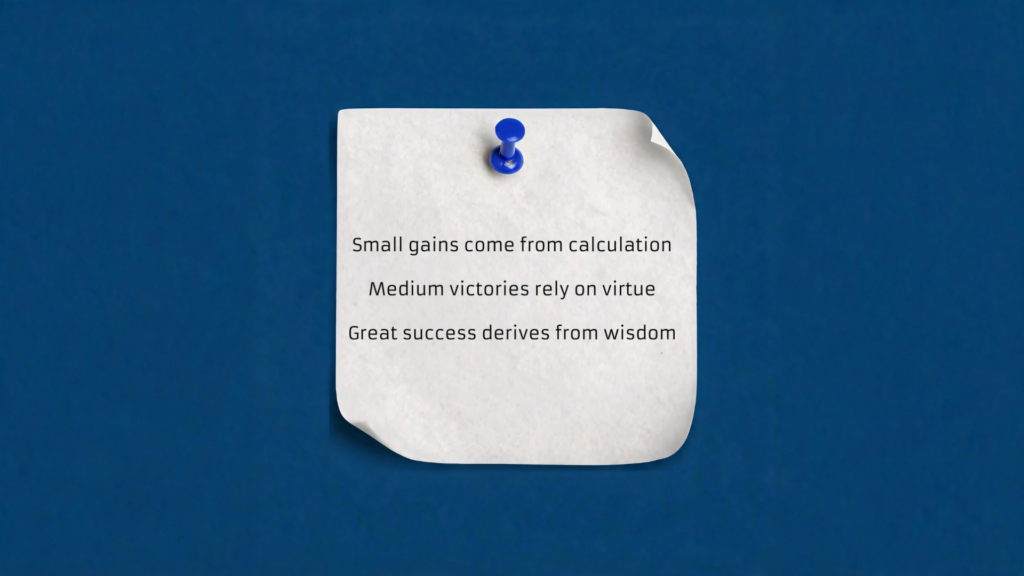
Although the two terms are often used interchangeably, they operate on different levels. In decision-making, intelligence is associated with calculation, analysis, and logical reasoning. Wisdom goes beyond logic and incorporates moral consideration, long-term vision and deeper insight. As the saying goes, small gains come from calculation, medium victories are built on virtue, and great success relies on wisdom.
I. Balancing Information and Inner Clarity
Intelligence enables us to gather information and process it through logical thinking. Wisdom includes intelligence but extends further. In traditional Chinese philosophy, wisdom is associated with a heart free of distractions and bias. When the mind is free from self-focus, it becomes easier to access deeper inspirations.
While intelligence may drive short-term results, wisdom ensures limitless professional longevity. All of us can recall important decisions that were not derived solely from analysis. Instead, they emerged from the integration of experience, intuition, and reflection. By quieting the mental noise, you unlock the ability to bypass linear logic and make high-level, instinctual decisions that define the visionary.
II. Improving Thinking and Decision-Making
There are two paths to improving the quality and efficiency of thinking.
The first is through long-term accumulation and systems training. By developing a coherent understanding of people, events, and principles, leaders and individuals become better at recognising the patterns and placing new challenges within an established framework. Over time, this leads to more effective judgment, even though the effectiveness could still not be guaranteed.
The other one is cultivating the mind. Through concentration and reflection, wisdom develops. As Wang Yangming, a Chinese neo-Confucian philosopher, observed, a great general remains unmoved amid chaos while responding appropriately to changing circumstances. This comes from inner clarity rather than mental calculation alone.
III. Transitioning Knowledge to Wisdom
Intelligence and wisdom are not opposites, but they develop in different directions. Overreliance on intelligence can lead to overconfidence and, therefore, limit deeper understanding.
Wisdom requires moving beyond analysis toward the cultivation of the mind. Through years of study and meditation, I came to realise that intelligence alone is inadequate compared to the depth of wisdom. Transformative growth comes from transcending knowledge to developing the insight required for better decision-making — an essential process within Heart-Centred Leadership, based on the 3M framework: Material, Mental, and Mind.